Lean Six Sigma Training Guide
  • IASSC Free Training Guide
  • Free Lean Six Sigma Training Guide
  • ASQ Free Training Guide
  • Body of Knowledge
  • Practice Exams
    • Six Sigma Quick Training Tests >
      • Lean Six Sigma Practice Test 1
      • Lean Six Sigma Practice Test 2
      • Lean Six Sigma Practice Test 3
      • Lean Six Sigma Practice Test 4
      • Lean Six Sigma Practice Test 5
      • Lean Six Sigma Practice Test 6
      • Lean Six Sigma Practice Test 7
      • Lean Six Sigma Practice Test 8
      • Lean Six Sigma Practice Test 9
      • Lean Six Sigma Practice Test 10
      • Lean Six Sigma Practice Test 11
      • Lean Six Sigma Practice Test 12
    • Six Sigma DMAIC Training Tests >
      • DEFINE Six Sigma Training Test
      • MEASURE Six Sigma Training Test
      • ANALYZE Six Sigma Training Test
      • IMPROVE Six Sigma Training Test
      • CONTROL Six Sigma Training Test
    • IASSC, ASQ and Other Exams >
      • IASSC Six Sigma Black Belt Exam
      • IASSC Six Sigma Green Belt Exam
      • IASSC Six Sigma Yellow Belt Exam
      • Lean Six Sigma Exams By Topic >
        • I. Enterprise-Wide Deployment >
          • A. Enterprise-wide view
          • B. Leadership
        • II. Organizational Process Management and Measures >
          • A. Impact on stakeholders
          • B. Critical to x (CTx) requirements
          • C. Benchmarking
          • D. Business performance measures
          • E. Financial measures
        • IV. Define >
          • A. Voice of the customer
          • B. Project charter
          • C. Project tracking
        • V. Measure >
          • D. Basic statistics
      • ASQ Six Sigma Black Belt Exam
      • ASQ Six Sigma Green Belt Exam
  • Six Sigma Materials
    • The Problem Solving Strategy Y = f(x) in Lean Six Sigma
    • Value Stream Mapping Explained
    • Pareto Analysis And Pareto Chart Explained
    • Best 5 Free Online Degree Programs In 2017
    • Cost Of Poor Quality (COPQ) Explained
    • Best 4 Free Online Certifications To Boost Your Resume
    • Pareto Analysis and Pareto Chart
    • Why Six Sigma Certification?
    • Six Sigma Green Belt Training
    • General History of Six Sigma & Continuous Improvement
    • Walter Shewhart Biography
    • Basic Lean Six Sigma Metrics
    • How to Make a Histogram
    • Statistical Process Control Charts
    • Lean Six Sigma Term Glossary
    • Kaizen and Kaizen Blitz
    • Central Limit Theorem
    • Six Sigma Symbols
    • Six Sigma Tables >
      • Z Score Tables
      • T Distribution Table
      • Chi-Square Distribution Table
      • F Distribution Table
      • Poisson Distribution Table
      • Cumulative Poisson Distribution Table
    • Six Sigma Diagrams >
      • Choosing a Right Parametric Test
      • Choosing a Right Control Chart
      • Commonly Used Lean Six Sigma Flowchart Symbols
      • Ishikawa (Fishbone) Diagram
      • Histogram
      • Scatterplot
      • Check Sheet
      • Failure Mode and Effects Analysis (FMEA)
    • Lean Six Sigma Belt Roles and Responsibilities
    • 5S
    • How to get six sigma certified?
    • International Six Sigma Certification Association (IASSC) Exam Reference Document
    • Useful Websites and Tools
    • 10 Best Free Udemy Courses That You Can Take Online
    • 5 Best Udemy Courses You Can Take Today
    • The Complete Web Developer Course 2.0 You Can Take Online | Udemy
    • 12 Best Probability and Statistics Online Courses and Classes [2018 Guide]
    • 15 Best Data Science Degrees, Courses and Certifications [2018]
  • Six Sigma Glossary
    • 5 Whys
    • Analytical and Descriptive Statistics
    • Brainstorming
    • Cost Of Quality
    • Design for Six Sigma (DFSS)
    • Efficiency of Estimators
    • Process Maps and Flow Charts
    • Gap Analysis
    • Common & Special Cause Variation
    • Quality Function Deployment (QFD)
    • In Control Process
    • Interest-Based Bargaining
    • Internal Customer
    • ISO9000
    • Kaizen Blitz
    • Kanban
    • Kano Model
    • Key Performance Indicators (KPI)
    • Lean Production
    • Management Strategies
    • MANOVA
    • Multivariate Analysis
    • Pareto Charts
    • Pareto Principle
    • PEST Analysis
    • Porter's Five Forces Analysis
    • Factor Analysis
    • Procedures
    • Process
    • Project Charter
    • Project Sponsor
    • Pull Production System
    • QS9000
    • Random Sampling
    • Failure Mode & Effects Analysis (FMEA)
    • Rolled Throughput Yield
    • Root Cause Analysis
    • Scenario Planning
    • Seven Quality Tools
    • SIPOC Diagrams
    • Six Sigma
    • SWOT Analysis
    • Systematic Sampling
    • System (Quality System)
    • Team Tools
    • Theory of Constraints
    • Throughput
    • Total Productive Maintenance (TPM)
    • Touch Time
    • Value Stream Maps
    • Visual Factory
    • Work In Progress (WIP)
    • Work In Queue
    • Work Instructions
    • Big Y
    • Control Plan
    • Waste
    • Evolutionary Operation of Processes (EVOP)
    • Cause & Effect Diagrams
    • 5C
    • 5Z
    • Project Selection
    • 8D Process
    • Appraisal Cost
    • Audit
    • Baseline
    • Business Process Quality Management
    • Check Sheet
    • Unintended Consequences
    • Voice Of The Customer (VOC)
    • Critical to Customer (CTC)
    • Critical To Quality (CTQ)
    • Customer Focus
    • Efficiency
    • Empowerment
    • Entry Criteria
    • Exit Criteria
    • Voice Of The Process (VOP)
    • Just In Time (JIT) Manufacturing
    • KISS
    • DMAIC
  • Six Sigma Blog
  • Forum
  • About Me
  • Privacy Policy
  • Contact
  • Top Free Online Courses With Printable Certificates
  • Roman Numerals Chart

Statistical Process Control in Sales Management 

11/3/2015


Statistical Process Control in Sales Management

By Timo Sivula
http://www.finngrowth.com

More often than not account and sales managers are artists more than scientists. A good phone sales person can perform a hundred times better than the average sales person. Personal features such as voice, empathy and persuasion skills make all the difference in sales, be it then over the phone or in a business to business sales meeting. Measuring personal features is difficult to do and it is easy to conclude that Statistical Process Control SPC has no place in sales. Especially in a market with strong seasonal variations, SPC may not seem like the most appropriate tool to apply. 
 
It is easy to focus on the personality of the sales person and forget the most important part of sales: hard work. You may have the best skilled sales executive on the planet but if he does not make a single call, does not send a single offer and does not meet any customers, you will not sell anything. Despite all the magic in good sales, the act of selling is a process. And as any other process, the sales process can be measured and improved. I would dare to say that a hard working mediocre sales person beats the gifted lazy one. Hence, with a systematic approach to sales results can and will be improved with Statistical Process Control SPC.

Applying the Ishikawa diagram and XY analysis to find key inputs to sales process 

Typical outputs, the Y's of a sales process are sales volume and sales margin. To improve these the inputs, the X's need to be identified. A good way to find key inputs is to use the Ishikawa, or fish bone diagram, listing all possible reasons to less than satisfactory sales performance. Typical inputs could be: number of cold calls per sales person per week, number of offers sent to customers, number of calls made to customer after offer has been sent, number of customer meetings per sales person per week, etc. The X's vary depending on the company and the industry. A properly executed Ishikawa analysis will provide for enough coverage of the inputs affecting sales performance and the key inputs can be identified. Alternatively an interrelationship diagram can be used to identify those X's that influence the Y and the other X's the most. 

Measuring sales using control charts 

The key inputs found by the XY-analysis can easily be analysed by Control Charts. However, if the markets show strong seasonal variations, these need to be taken into account and normalised. Typical examples of natural seasonal variations are the market changes for agricultural equipment in four season environments. A good way to normalise such fluctuations is to use the seasonalized sales budget as a divisor to achieve a number that is relative to budget and market state. For example: if delivery of harvest equipment happens from June to September, the actual sales actions need to happen early enough, for example during the first quarter of the year. More cold calls and customer meetings are planned in Q1 than in Q3. The measured number of sales calls is divided by the budgeted number of sales calls. The results is a relative percentage that is comparable to all other months of the year, provided the budget is properly done. 

For sake of simplicity in the following example, lets assume the product to be sold is a household product that is sold door to door. It is fairly obvious one key input to the sales process is the number of customer visits per sales person per day. A commonly accepted standard sample size for control charts is 30 samples. Assuming a 5 day working week we need 6 weeks to gather necessary data for the sales persons. As every process, the door to door sales process will exhibit variation and a mean. Plotting the results on a control chart we will quickly identify mean, Upper Control Limit UCL and Lower Control limit LCL and whether the process is in control or not.  

Analysing measurements, common and special cause variation 

By definition all processes have common cause variation and special cause variation. Common cause variation is very difficult to eliminate, whereas special cause variation is the key focus area for improvement work. Any sample outside the control limits, or other defined rules, is caused by special cause variation. Let's take the example of our door to door sales person. He has an average of 6 customer visits a day and UCL at 8 and LCL at 4 visits per day. In the analysis we find one day with 0 meetings and one with 9 meetings. Looking at these two closer we may find that he was able to make 9 visits one day because he was working in a tightly populated area and the 0 was caused by him being ill that day. Both are fully valid special causes. Medical leave may or may not be worth its separate control chart to make sure it stays in control. The fact that the density of houses affects the number of customer visits may be used as an input to the next phase where the sales process is to be improved. We do not worry for the variation that happens within the control limits at this point. 

Using Statistical Process Control analysis results to improve sales process outputs, the Y's 

The results from the control charts are interpreted and clues for improvement ideas are sought for. The key suspects for improvement areas are the out of control samples. If there are a lot of absences due to medical reasons this can be difficult to change quickly. A program to improve the health and job satisfaction of the sales personnel should probably be started. A faster way to improve Y is to plan the sales work into areas with denser population to enable the sales persons to spend less time moving from customer to customer and more time meeting customers.  

In this simplified example the key improvements to the sales process are a) the setting up of a job satisfaction and health program for sales persons and b) improving the planning of the sales route for the door to door sales person. Separate Kaizen projects are set up for each of these improvement areas. A good project brief defines the start and end for the Kaizen projects, which also defines when the next measurement is to be done.

Confirming improvement results using control charts 

Once the Kaizen projects targeted at improving the inputs, the X's of the sales process have concluded, a new sample of the inputs is taken. In our example 6 weeks of customer meetings per sales person is measured again. If both Kaizen projects, the one focusing on job satisfaction and the other on sales route planning, succeed the mean of the new sample should show a clear improvement and the special causes identified in the previous measurement should be absent. Provided no new special causes have appeared during the improvement projects, the process should also show no out of control samples and thereby by definition be in control. Now is the time to have a look at the Y, the output. If the selection of inputs to improve was done correctly and the Kaizen projects have been successful, an improvement of the sales volume and margin should be visible. The statistical significance of the difference is confirmed with a statistical test suitable to the sample type used, using e.g. Minitab or SigmaXL.

Sustaining the results achieved using Statistical Process Control

Once the  improvement of the output has been confirmed, it is time to create an Out of Control Action Plan OCAP. The Upper and Lower Control Limits of the Control Charts are mathematically calculated to indicate process stability, they do not reflect process specification limits. Hence, the Sales Management sets specification limits for the inputs, i.e. how many sick leaves can be tolerated and what are the Upper and Lower Specification Limit for them. In a similar manner specification limits are set for the number of customer visits per day per sales rep. The sales assistant is given the responsibility to weekly update a range chart measuring these two inputs. The charts are reviewed in the weekly sales meeting and the sales director presents them in his monthly report to the company steering group. Actions are agreed on how to react when specification limits are exceeded. The Sales Director makes sure those actions are executed without delay if an out of control situation is detected. Over time the new level of sick leave and daily customer meetings will become the "new normal". 

Statistical Process Control in Sales Management Conclusion

The example above was a simplification of a sales process with identified special causes. Control Charts are a good tool to separate special cause variation from common cause variation. The root causes for the special cause variations are the most valuable clues to the improvement work. By removing the special reasons to under performance and developing the process towards the over performing special cases, the mean of the process is improved. Ultimately this will yield the desired improvement to the output Y, as Y=F(X) .

What is 6 Sigma?

10/14/2015


What is 6 Sigma?

If you have heard of such modern management buzzwords as process excellence, quality improvement, streamlining, you would also likely hear about 6 sigma. So what is 6 sigma? It is a quality improvement methodology which originated at Motorola in 1980s and due to its benefits for organizational effectiveness and profitability spread among a large number of companies. This methodology relies on the application of various visual analytical tools (e.g. Control Charts, Fishbone diagram, Pareto Chart, Failure Mode Effects Analysis) and statistics to identify deficient processes, define root causes and improve and control these processes.  

The whole approach revolves around the goal to reduce variation in processes which cause deficiencies. For example, let’s take a mortgage lender whose goal is to close loans within 30 days. There would be a natural variation in the loan closure timelines. In other words some loans would be closed in 25 days, others in 28, 32, or even in 45. The more variation there is in closure timeliness in excess of 30 days, the less customers will be happy. Nobody would like to wait 35 or 42 days when a bank promises 30. This can effectively lead to a decline of the lending business. A 6 sigma project would focus on reducing loan closure timeline variation. Specifically, the goal of such project would be significantly decreasing instances when the bank exceeds promised 30 days while closing mortgage loans.
Now you might ask how about the name? What is 6 sigma? If you may recall from your STAT 101, sigma is the same thing as standard deviation which is a measure of dispersion of data distribution. 6 is the number of deviations on the left and the right of the mean which comprises 99.9999998% of data. For the bank to achieve 6 sigma quality in its loan closure timeliness, it would mean that 99.9999998% of the time the bank would not exceed promised 30 days. Therefore, 6 sigma is not just a quality improvement methodology, but also a very high quality standard. Achieving this standard brings excellence and excellence leads to profitability and increased effectiveness.
Read more:
How Much It Costs to Take Six Sigma Certification Exam
About Six Sigma Certification
Why Six Sigma Certification
History of Six Sigma
Lean Six Sigma Belt Roles and Responsibilities

Below is an inforgraphic from Villanova University which has good visual explanation of what lean six sigma is.
What is 6 Sigma?

Six Sigma Green Belt Salary

10/14/2015


Six Sigma Green Belt Salary

You might have heard from coworkers or learned on LinkedIn (or somewhere in cyberspace) about lean six sigma certification. You would also hear about professional recognition and earnings boost which it brings. This is all true. Professionals who earned six sigma belts normally tend to enjoy higher professional status and tend to get preferences during job selection or promotion. You can also expect larger paychecks with six sigma certification.

As I mentioned in my previous post, black belts (the highest belt level after rare Master Black Belt) earn annual $98,370 in the US. However, not everyone is well versed in statistics and has enough time and dedication to take on six sigma black belt certification exam preparation challenge which can take months of studying and may require project completion to satisfy certification requirements. The good news is that there is a green belt certification which still will provides an increased professional status and boosts earning potential. Let’s take a look at six sigma green belt salary figures as of May 2015.

According to a popular job search website Indeed.com, an average six sigma green belt salary in the US is $83,000 per year. This average salary is 44% higher than average salaries for all job postings nationwide. With this annual paycheck your bi-weekly earnings would be $3,192.
Six Sigma Green Belt Salary
On the chart you can see how six sigma green belt salary compares to those of fifteen related jobs nationwide. Although the green belt salary is less than what black belts make, it still surpasses the earnings of such occupations as 
quality engineer or lean manufacturing coordinator. If you are a detail oriented person, you would notice that black belt has a duplicate listing. I checked and the one with $72,000 is erroneous. So disregard it.

Now let’s look into how an expected six sigma green belt salary varies based on geographic location. In Big Apple (New York City) you could earn $100,000 as a six sigma green belt certification holder. On the West Coast your wage could either be lower than that of NYC or surpass it depending where you end up getting hired. In the City of Angels (Los Angeles) you are likely to take in $89,000 per year, whereas in San Francisco your anticipated average annual paycheck can hit $112,000. In Memphis, Tennessee the average salary drops to $75,000. However, considering lower cost of living, this may be a comparable wage. In the nation’s capital, Washington DC, green belts earn an average of $104,000.

The green belt level six sigma certification is a good way to get your feet wet in the world of quality management. It will require less effort than preparing for the black belt exam, but sill would provide you with good return on your investment of effort and time bringing you more professional recognition and the potential to increase your salary. If you do not want to spend a fortune on training and have enough discipline to pursue self-guided six sigma training, you can get started with www.sixsigmatrainingfree.com . This is a website which I put together after I successfully passed my black belt exam. It will help you organize your self-guided training and will point you to valuable online resources which I have located over 2 months of research. Good luck!

Read more:
How Much It Costs to Take Six Sigma Certification Exam
About Six Sigma Certification
Why Six Sigma Certification
History of Six Sigma
Lean Six Sigma Belt Roles and Responsibilities

Six Sigma Certification Cost

10/14/2015


Six Sigma Certification Cost

Unless you are taking a six sigma training and certification provided by your employer, you are likely to spend some hard earned bucks on the certification exam. A typical six sigma certification cost varies between under $100 to $700 depending on the belt level and whether training is included with certification. Some six sigma training providers do not offer just certification exams and require you to pursue their training in order to be allowed to take a certification test (e.g. goleansixsigma.com). As a side note, I have to say that the fact that most six sigma certification exam providers require taking their training is a bit sketchy. You do not need to be a genius to realize that there is an inherent conflict of interest in such an approach. But anyhow, let’s not digress and get back to six sigma certification cost.

One of the often sought after six sigma certifications are provided by the American Society for Quality (ASQ).  If you are a six sigma rookie, you can take a yellow belt exam for $339 as a non-member. For members ASQ offers a discounted $189 price tag. In case you are not successful, you can retake the exam for $129 per retake. This being said, I would not recommend spending that much money on the yellow belt certification as it only attests to one’s basic understanding of six sigma concepts and does not carry enough weight. Instead it would be a better idea to spend a bit more time on preparation and go after the green belt which costs just $20 dollars more at $359. You can save on this six sigma  certification cost by becoming ASQ member. For members the price is $209. Retakes would cost you $159. Once you obtain either yellow belt or green belt you do not need to recertify. Only black and master black belts are required to recertify every 3 years. You can take a black belt certification exam for $459 as a non-member. ASQ members can take the same exam for $309. Retakes cost $259. ASQ also offers a master black belt level certification for seasoned six sigma professionals which comes with a hefty price tag. The exam fee is $2150 for non-members or $1995 for members. You would also need to pay for a portfolio review process either $650 (member) or $495 (non-member). Your overall six sigma certification cost for the master black belt would be $2,800 (non-member) or $2,400 (member). The downside of the ASQ examinations is that they are not offered online but on-site, and you may need to wait before exams become available close to your location.

Goleansixsigma.com offers certification exams at yellow, green and black belt levels online. If you still decide to go after yellow belt, you can do so for $79. Green and black belt certification exams are offered in combination with training. The training and certification exam for green belts costs $699 and you do not have to recertify. In case you are not successful on your first attempt you can retake for free. For black belt candidates, the six sigma certification cost at this level is $899 and there is a prerequisite to have the green belt from goleansixsigma.com.
Similar to goleansixsigma.com the International Association for Six Sigma Certification (IASSC) offers six sigma certification exams which can be taken any time online from home. This organization seems to strive to become an impartial certification body and does not offer training. IASSC is exclusively focused on exam administration. The six sigma certification cost for the yellow belt is $195. Green belt candidates can take a certification exam for $295. The highest belt level which IASSC offers is black belt which will cost you $395. Unfortunately, if you are unsuccessful on your first attempt there is no discount for retakes. You would need to pay the full price again. The advantage is that there is no recertification requirement for yellow belt, green belt and black belt holders.

There is no single six sigma certification authority and therefore you can find a large number of organizations which administer certification exams. Although this post reviewed just a small sample of them, ASQ and IASSC seem to be some of the most recognizable and reputable. No matter which organization you choose for getting certified, you would need to prepare. If you feel that certification exams are already expensive and would like to prepare on your own, you can visit www.sixsigmatrainingfree.com for free six sigma preparation materials and practice tests. That’s how I passed the black belt exam with IASSC. With a  bit discipline and determination you can do too.

 
Read more:
What You Can Expect as a Six Sigma Black Belt Salary
About Six Sigma Certification
Why Six Sigma Certification
History of Six Sigma
Lean Six Sigma Belt Roles and Responsibilities

Six Sigma Black Belt Salary

10/14/2015


What You Can Expect as a Six Sigma Black Belt Salary

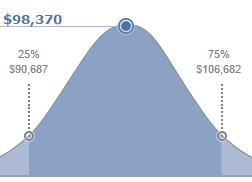
If you have been thinking of getting a lean six sigma certification, you would be familiar with various levels (belts) you could attain. You might know by now that the most desirable belt is black (apart from master black belt) as it is a testament to one’s complete understanding of six sigma body of knowledge and the ability to lead and successfully implement quality improvement projects. However, this is not all. In addition to professional recognition, you can expect to earn sizable six sigma black belt salary. Let’s have a look at salary figures as of April 2015.

According to Salary.com, an annual US national median six sigma black belt salary is around $98,370. With this salary you could expect a bi-weekly paycheck of $3,783. 
What You Can Expect as a Six Sigma Black Belt Salary
And this is a base salary excluding benefits and a bonus. Throwing a bonus into equation would bring a holder of six sigma black belt certification to an annual $101,290. The benefits could add additional 20-30Ks. For comparison, according to Indeed.com six sigma green belts (the certification level just below black) make annual $83,000 as a base pay. Therefore, a six sigma black belt salary is expected to be $15,000 greater than that of a green belt.

The base pay amount of a six sigma black belt salary varies depending where you live. In the nation’s capital Washington DC, you can expect to bank annual $108,600. In San Francisco, California a black belt could make an even higher $120,119 as an annual base salary. If life takes you south to New Orleans, Louisiana, you could still take in slightly above the US national median at $99,058 per year. In smaller towns such as Athens, Georgia you will likely make less than the national median.  A typical six sigma black belt salary in this university town will be around $88,926. Being below the median national earnings, this is likely to be a sizable pay relative to the cost of living, as Athens is cheaper than San Francisco or Washington DC. 
If you feel that the professional recognition and higher earnings justify preparation for a certification exam then it is time to hit the road. You have several options to get trained. You can enroll in an on-line or an on-site training provided by companies such as Villanova University, Gamba Academy etc. Such trainings tend to come with a hefty price tag. But if you need full guidance in your training and don’t mind to drop over $1,000, this might work for you. You should also ask around and see if your company/organization offers any six sigma preparation courses for its employees. Some of the companies do (e.g. Motorla, GE). If you have enough self-discipline and would like to prepare on your own without spending a fortune, you can use free on-line resources. The best on-line free website for six sigma training is www.sixsigmatrainingfree.com. You can also complement your studies with books.

Read more:
How Much It Costs to Take Six Sigma Certification Exam
About Six Sigma Certification
Why Six Sigma Certification
History of Six Sigma
Lean Six Sigma Belt Roles and Responsibilities

Six Sigma Certification

10/14/2015


Six Sigma Certification

Obtaining this certification is not only a salary booster, but also a path to increased job opportunities. If you are thinking of changing a job, having a green or black belt certificates will tangibly augment the number of interested organizations and therefore a number of interviews. For any given job application, most hiring managers between two candidates with similar credentials would likely give preference to someone who has passed a six sigma certification exam. So it is likely to lead to higher earnings and increased job opportunities. 
If you have been thinking about advancing your knowledge as business / government professional or are just trying to find a better job, professional certifications can certainly help. One of the most valued and recognizable is lean six sigma certification. Getting certified as a six sigma professional is not only a testament of one's knowledge of quality management techniques and advanced statistic, but also a potential salary booster.Black belt holders (one of the highest certification levels) make around $100,000 annually  in the US as base salaries. Not bad considering today's competitive market.
Furthermore, preparing for the exam will help you organize your knowledge about management, quality control and statistics and help you think in more organized manner. This will enable you to solve problems more effectively and with less stress.

Now, that you are convinced six sigma certification may be useful for your professional career growth, you probably have two questions: where should you get certified? and, how should you prepare for the exam? Well, there is no single organization for six sigma similar to Project Management certification which is administered by PMI. Instead a number of organizations provide master black belt, black belt, green belt and yellow belt seekers with an opportunity to take certification tests. Some of the well known organizations are American Society for Quality (ASQ), International Association for Six Sigma Association (IASSC), Villanova University etc. A large number of American corporations such as Motorola, General Electric, Amazon, Boeing, Bank of America, Ford Motors Company, Northrop Grumman and others provide in-house certifications for their employees and implement six sigma projects.

As far preparation goes, six sigma certification seekers have two options: paid and unpaid. You can take paid on-site or internet based training. Normally, the training is not cheap and can vary from $400 to $2,500. Well established and known training providers charge around $1500-$2000. In addition, most six sigma certification seekers end up taking exams with these training providers and have to pay additional $150-$400. 
_
However, there is a way to self prepare for a six sigma certification exam for free or for very cheap. If you are shooting for a green belt or black belt certification and have basic knowledge of statistics you can self prepare by using training materials which are available online at www,sixsigmatrainingfree.com for free and compliment your studies with fairly cheap books. On this web site you can find black belt body of knowledge (BOK) for six sigma certification exams administered by American Society for Quality (ASQ) and International Association for Six Sigma Certification (IASSC). If you are shooting for a green belt or a lower certification (yellow belt or white belt) you will still find the ASQ and IASSC black belt BOK based training guides useful. You will just need to remove some of more advanced topics from your preparation process.

You will also find a number of free practice tests and sample ASQ and IASSC exams.  Solving these tests and sample exam questions is crucial for self preparation. You will find these tests invaluable. Well, I hope this sums the benefits of obtaining six sigma certification and provides helpful tips for exam preparation. Good luck!

Read more:
How Much It Costs to Get Six Sigma Certified
What You Can Expect as a Six Sigma Black Belt Salary
About Six Sigma Certification
History of Six Sigma
Lean Six Sigma Belt Roles and Responsibilities
Forward>>

    Six Sigma Blog

    Everything about lean six sigma

    Archives

    June 2020
    February 2020
    January 2020
    August 2019
    February 2019
    August 2018
    November 2015
    October 2015

    Categories

    All

    RSS Feed