
Total Productive Maintenance (TPM)
Total Productive Maintenance (TPM) is a Lean approach to equipment that makes everyone — not only the maintenance department — responsible for keeping machines running, with the goal of no breakdowns, no small stops or slow running, no defects, and no accidents. It was developed in Japan by Seiichi Nakajima and the Japan Institute of Plant Maintenance (JIPM) in the 1970s. TPM builds on Lean basics such as 5S, standard work, and kaizen, and it is usually measured with Overall Equipment Effectiveness (OEE).
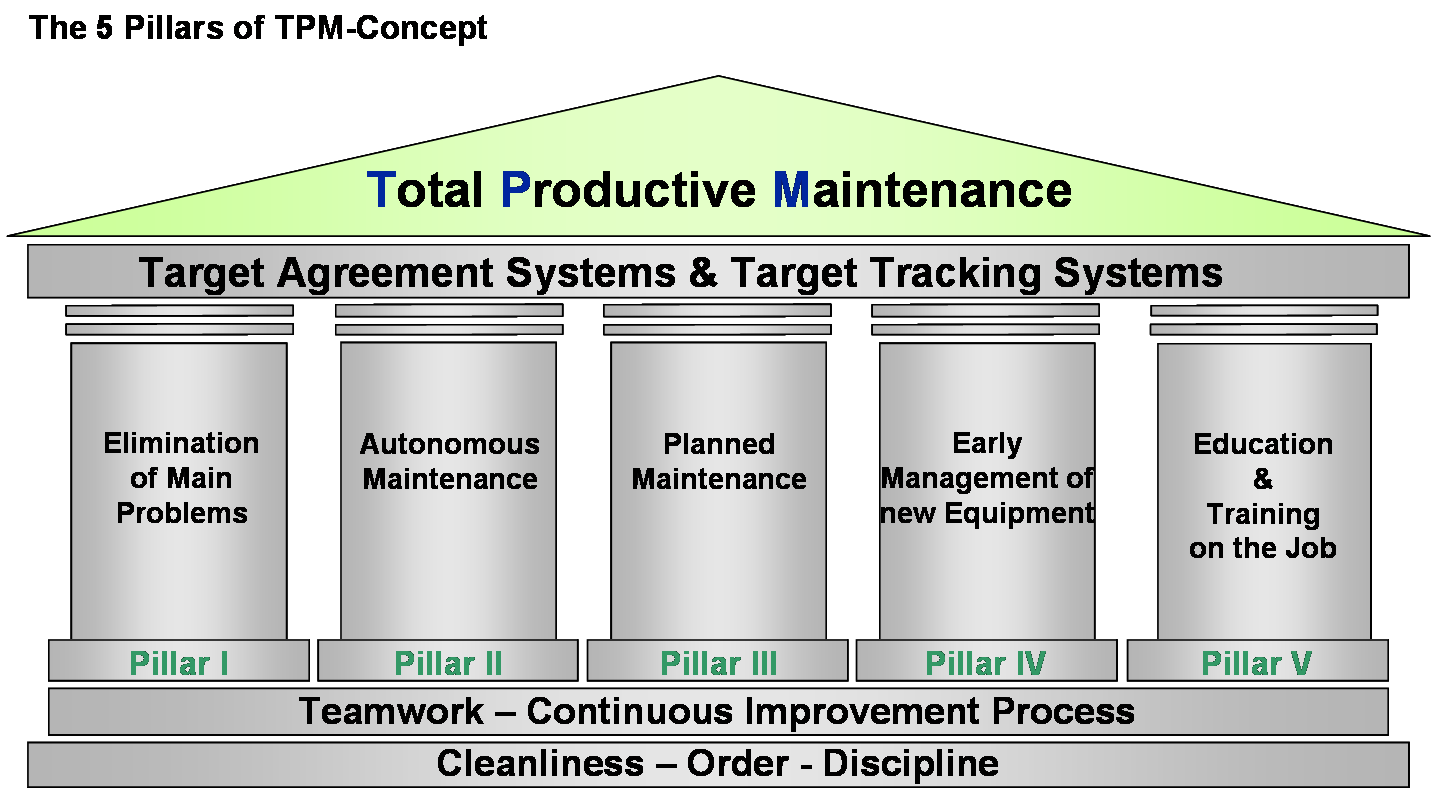
The eight pillars of TPM
- Autonomous maintenance (jishu hozen): operators clean, inspect, lubricate, and tighten their own equipment and spot problems early.
- Planned maintenance: scheduled work based on failure history and condition, including the preventive and predictive maintenance described below.
- Quality maintenance: keep equipment in the condition that produces no defects.
- Focused improvement (kobetsu kaizen): small teams attack chronic losses on specific machines.
- Early equipment management: design new equipment from past lessons so it is easy to run and maintain.
- Training and education: build the skills operators and technicians need.
- Safety, health, and environment: remove hazards as part of the same routine.
- TPM in administration: apply the same loss-cutting thinking to office processes.
More detail on the pillars is in 8 supporting activities of TPM, and a rollout plan is in how to implement TPM.
Maintenance types TPM draws on
| Type | What it means |
|---|---|
| Preventive maintenance | Periodic (time-based) and predictive (condition-based) work done before failure |
| Breakdown maintenance | Fixing equipment after it fails |
| Corrective maintenance | Improving equipment so the same failure does not happen again |
| Maintenance prevention | Studying existing machines to design out failures and make maintenance easier on future equipment |
TPM differs from routine maintenance, where operators only make minor repairs: in TPM, operators own basic care, and maintenance staff move toward planned work and improvement.
Measuring TPM with OEE
OEE = Availability × Performance × Quality. Availability is run time ÷ planned production time; Performance is actual output ÷ the output possible at ideal cycle time; Quality is good units ÷ total units. For example, 90% availability × 95% performance × 98% quality = 83.8% OEE. OEE is built around the six big losses: breakdowns, setups and adjustments, small stops, reduced speed, startup rejects, and production rejects.
Frequently asked questions
Who created TPM?
TPM is credited to Seiichi Nakajima of the Japan Institute of Plant Maintenance, who developed and promoted it in Japan in the 1970s.
Is TPM the same as preventive maintenance?
No. Preventive maintenance is one input. TPM is a whole-plant system that adds operator ownership, loss-focused improvement, and OEE measurement.
Last updated: · Published by Lean Six Sigma Training Guide (sixsigmatrainingfree.com) · How this guide is written