
5C
5C is a workplace-organization method that is equivalent in spirit to 5S. The five Cs — Clear out, Configure, Clean and check, Conformity, and Custom and practice — are an English wording used in some Lean programs (often in the UK and in Nissan-influenced teaching) for the same job as Sort, Set in order, Shine, Standardize, and Sustain.
The aim is a stable, safe workplace that supports cost, quality, and delivery, and that people can keep without a one-off tidy-up campaign.
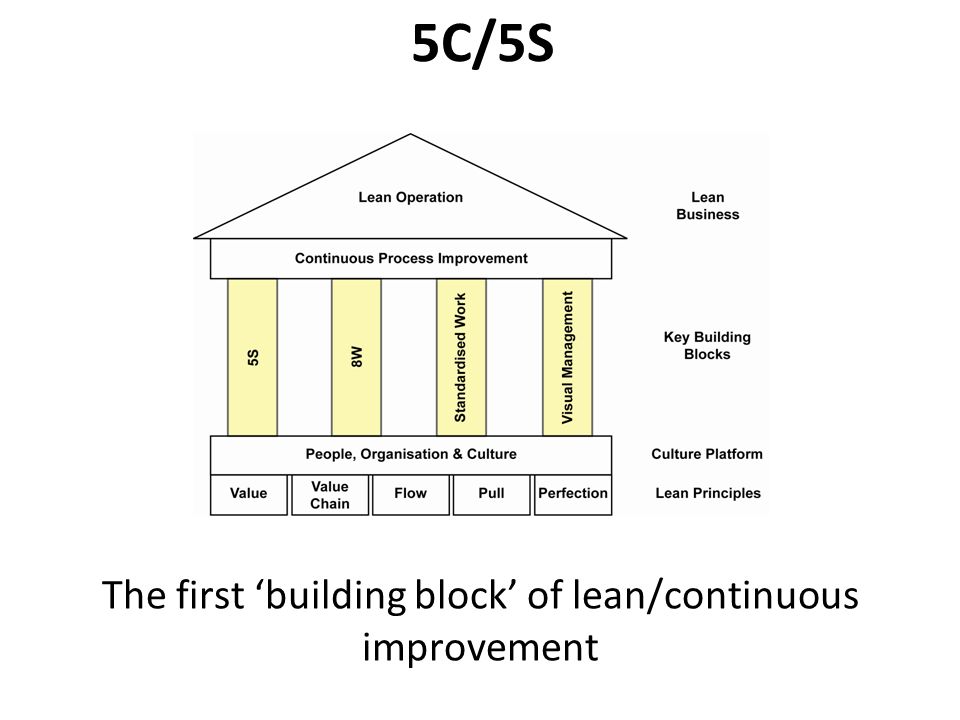
The five Cs in practice
- Clear out. Separate what the job needs from what it does not. Red-tag or remove excess tools, old fixtures, and mystery boxes. This is Sort.
- Configure. Give every remaining item a home, close to where it is used, and mark that home. This is Set in order: shadow boards, floor tape, labeled bins. Northriver’s hinge pack bench, for example, would have a marked place for bags, cards, and torque tools, not a shared junk drawer.
- Clean and check. Clean so you can see abnormal conditions — leaks, cracks, missing screws, chips on a die. Shine is inspection, not a cosmetic sweep.
- Conformity. Standardize the first three so every shift uses the same layout, the same checks, and the same work instructions. Improve the standard when you find a better way, then lock that in.
- Custom and practice. Sustain. People know the rules, see why they help, and hold the standard without a supervisor standing over the tidy-up. Audits and leader walks support the habit; they do not replace it.
How is 5C different from 5S?
Treat 5C as a translation, not a competing system. Some sites also use terms like CANDO (Cleanup, Arranging, Neatness, Discipline, Ongoing improvement). The content you already have on 5S — red-tagging, visual homes, shine as inspection, standardization, and sustain — applies here. Pair either method with a visual factory so a missing tool or an overflowing WIP square is obvious from the aisle.
What does not work is running Clear out once, taking photographs, and skipping Conformity and Custom and practice. The workplace then slides back in a few weeks, which is why 5C (and 5S) are often blamed for “not sticking.” The last two C’s are the method.
Exam notes
If a question lists Clear out, Configure, Clean and check, Conformity, and Custom and practice, it is asking about 5C and expects you to map those steps to 5S. Do not confuse 5C with the “5 Cs of credit” or other unrelated five-C lists. The Lean meaning is workplace organization.
Frequently asked questions
Do I need to rename our 5S program to 5C?
No. If the plant already speaks 5S, keep it. Use 5C wording when you are in a curriculum or a site that already uses it, and keep the five habits aligned.
Is 5C only for factories?
No. The same sequence works in a warehouse, a clinic, or an office: clear what you do not need, configure what you do, clean so problems show, make the setup the standard, and practice it until it is habit.
Last updated: · Published by Lean Six Sigma Training Guide (sixsigmatrainingfree.com) · How this guide is written