
Pull Production System
A pull production system makes products only when there is actual demand for them. A customer order or a downstream step that has used up its stock sends a signal, and only then does the upstream step produce more. A push system does the opposite: it schedules production from a forecast and pushes the output toward the customer.
In Lean production, pull is preferred because it keeps inventory, waiting, and overproduction low.
What is the difference between pull and push production?
When you talk about Lean production, there are two types of production system: pull and push. In a pull system production is driven by demand. When a product has demand, it continues to be produced; when demand falls, production falls; when demand rises, production rises; and when there is no demand for that product at all, it is not produced. A push system is the traditional approach: production is scheduled in advance from expected demand. Push systems usually weigh more on the organization, because they carry much larger inventories of parts and finished items.
| Push system | Pull system | |
|---|---|---|
| What starts production | A forecast and a schedule (often from MRP) | Actual consumption or a customer order |
| Inventory | Large buffers between steps and in the warehouse | Small, capped buffers (supermarkets) or none |
| Response to a demand change | Slow; the forecast has to be revised first | Fast; signals stop or speed up right away |
| Main risk | Overproduction, obsolete stock, hidden defects | Stock-outs if demand is very unstable or lead times are long |
| Typical fit | Long supplier lead times, highly seasonal products, one-off projects | Repeating products with fairly steady demand |
How does a pull system work?
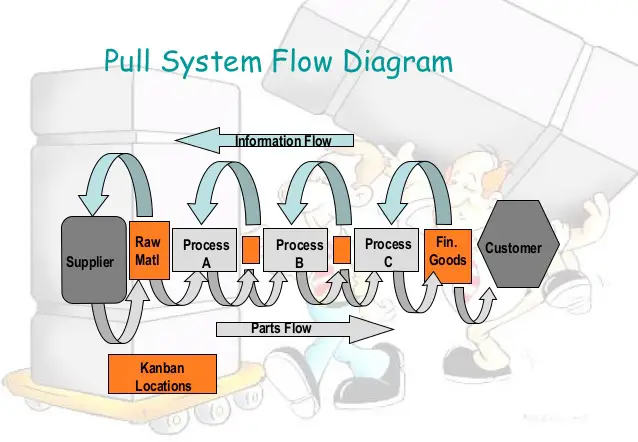
- The customer takes product. A finished item leaves the last step or a small finished-goods store.
- A signal goes upstream. The signal can be a kanban card, an empty bin, a marked floor space, or an electronic message.
- The upstream step replaces only what was used. It builds the quantity on the signal and no more, so work in progress stays capped.
- The cycle repeats back through the process, to the first step and to suppliers.
Common forms are a replenishment (supermarket) pull, where each step keeps a small, fixed stock of each item and refills it as it is used; a sequential pull, where items are built to order in the sequence orders arrive; and a mixed system that uses supermarkets for high-volume items and build-to-order for the rest. Some plants also cap total work in progress across a line (often called CONWIP) instead of between every pair of steps.
Why pull reduces waste
Pull attacks overproduction, which Lean treats as the worst of the eight wastes because it creates the others: extra inventory, transport, waiting, and defects that hide in piles of stock. By Little’s Law, average lead time equals average work in progress divided by throughput, so capping WIP shortens lead time for the same output. Smaller queues also expose problems faster: if a step makes a bad part, the next step finds it within hours rather than weeks.
What you need before pull works
- Reasonably stable demand, or a plan to level it (often called heijunka, or production leveling).
- Short, reliable changeovers, so small batches are affordable.
- Reliable equipment and quality; total productive maintenance and poka-yoke keep a small buffer from running dry.
- Visual control, so everyone can see the signals (see visual factory).
- A pace set by demand: takt time is the available working time divided by customer demand for that period.
A simple example
A cell assembles three models of a pump. Instead of building each model to a monthly forecast, it keeps a small supermarket of two boxes per model in front of shipping. When shipping takes a box, the box’s kanban card goes back to the assembly cell, which builds one more box of that model. The machining area that feeds assembly does the same with its own small store of parts. Inventory between the steps is now fixed by the number of cards, and a drop in demand for one model simply means fewer cards come back for it. (Illustrative example.)
Pull in Lean and Six Sigma
Pull is one of the five Lean principles: specify value, map the value stream, create flow, establish pull, and pursue perfection. A value stream map usually shows where push should change to pull, and just-in-time (JIT) production is the wider system that pull belongs to. In a DMAIC project, a pull system is an Improve-phase solution for long lead times and high inventory; the Control phase then fixes the number of kanban cards and the rules for changing it. See also Lean production and the theory of constraints, whose drum-buffer-rope method releases work based on the bottleneck’s pace.
Frequently asked questions
What is a pull production system?
A system that produces only in response to actual demand. Downstream use or a customer order sends a signal upstream, and each step replaces only what was taken, so inventory and work in progress stay low.
What is the difference between push and pull production?
Push schedules production from a forecast and moves output toward the customer whether or not it is needed yet. Pull waits for a demand signal and builds only what was used. Push usually carries more inventory; pull responds faster to changes in demand.
Is kanban a pull system?
Kanban is the most common way to run a pull system. Each card or bin authorizes a fixed quantity of production or movement, so the number of cards caps the inventory in the loop.
When is a push system the better choice?
When supplier lead times are much longer than customers will wait, for highly seasonal or one-off products, or for very expensive items that are always built to a specific order and schedule. Many plants use push for planning and pull on the shop floor.
See also: Takt time: formula and line balancing
Last updated: · Published by Lean Six Sigma Training Guide (sixsigmatrainingfree.com) · How this guide is written